

Senior care / Innovation
Wearable robot senses loss of balance to prevent falls
By Andrew Sansom | 12 Sep 2022 | 0
Researchers in Singapore have developed a wearable assistive robot that can detect and prevent a fall before it happens, reducing the user’s risk of sustaining injuries.
The development of the robot, which can also be used to aid patients’ rehabilitation from their injuries, was catalysed by the National Robotics Programme, a multi-agency national programme that looks at the end-to-end development of differentiating robotics enablers and solutions in Singapore, from funding R&D to supporting partnerships for translation and adoption to maximise socio-economic impact.
Called the Mobile Robotic Balance Assistant or MRBA (pronounced ‘Mister-Bah’), the robot uses its inbuilt sensors to detect instantaneously a loss of balance and catches the user with its attached safety harness, which is worn around the user’s hips.
The device could also help users who have difficulty in walking and balancing to stand up safely from a seated position, and to sit down safely from a standing position. It also uses a depth-sensing camera to observe the user’s movements, while machine-learning algorithms estimate the balance state of the user in real time to better predict any future imbalances or falls.
The human balance control system degenerates with age. This is exacerbated by conditions such as neurological diseases and injuries, musculoskeletal problems such as ankle sprains, scoliosis, or missing limbs, as well as vertigo. This loss of balance control often results in falls, especially in the elderly.
According to the World Health Organization, falls are the second leading cause of death from accidental or unintentional injuries worldwide – and in Singapore, falls account for 40 per cent of injury-related deaths. 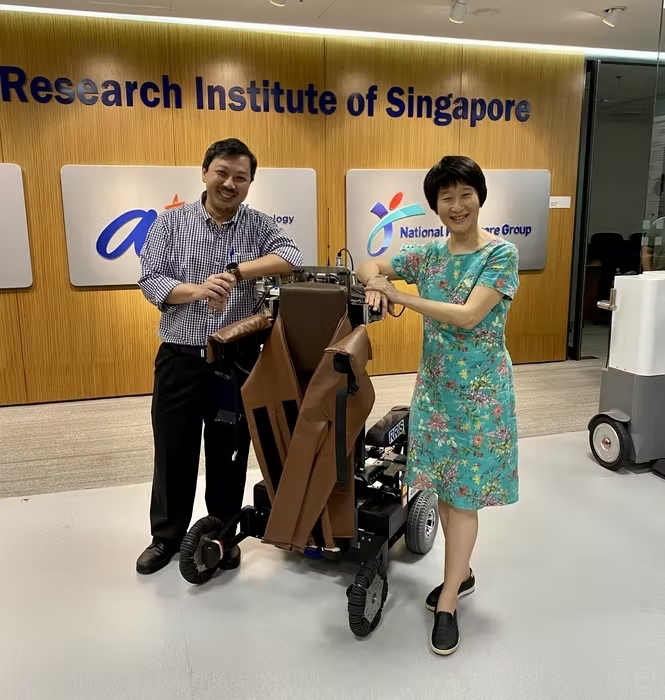
Intended for use with minimal caregiver help in both institutional and home settings, it can assist people with limited or reduced mobility in day-to-day tasks, such as entering and exiting elevators, opening doors, getting dressed, performing simple kitchen chores, and conducting tasks such as watering plants.
MRBA was co-developed by a team of researchers, engineers, and data specialists at the Rehabilitation Research Institute of Singapore (RRIS), alongside clinicians and researchers at Tan Tock Seng Hospital (TTSH). The RRIS, which is hosted at Nanyang Technological University, Singapore’s Lee Kong Chian School of Medicine, was founded by the University in 2016, along with the Agency for Science, Technology and Research, and the National Healthcare Group.
In clinical trials involving 29 participants, including patients who suffered from stroke, traumatic brain injuries, and spinal cord injuries, the researchers found that MRBA was successful in aiding them with sitting, standing, and walking, as well as assisting in tasks like fetching water. No falls were recorded in the trials, which took place over three days for each participant.
Promoting independent living and ageing
The technology presents an improved tool to help in the care of Singapore’s ageing population, reflecting both the NTU’s and TTSH’s commitment to using technology and innovation to respond to the needs and challenges of healthy living and ageing – selected as one of four of humanity’s “grand challenges” that the University seeks to address through its strategic plan.
Associate Professor Ang Wei Tech, executive director of the RRIS and who supervised the project’s development, said: “MRBA could prove to be an invaluable resource for older adult users, and help promote independent living and ageing. The development of the robot was as result of a fruitful collaboration with TTSH, blending our expertise in engineering and machine learning with their strengths in rehabilitation and medicine.”
Another co-lead in the project was Karen Chua, adjunct associate professor at NTU’s Lee Kong Chian School of Medicine, and senior consultant at TTSH’s Department of Rehabilitation Medicine. She said: “One of TTSH’s key strategies is to empower patients with greater access to innovative robotic rehabilitation. We want to make robotics therapies more sustainable and accessible in the community, where our patients can lead healthier and happier lives. The RRIS team’s innovative spirit and clear understanding of clinical needs have made them wonderful partners in developing this technology to support more people to live independently.
“In the near future, we look forward to seeing the MRBA improved to an industrial prototype with a software data platform that prepares it for commercialisation.”
MRBA’s success in the clinical setting has resulted in interest from Ninkatec and Home Instead, two home-care providers from Singapore. The research team has also filed four patents for the technology with NTUitive, the University’s innovation and enterprise company.
An everyday robotic assistant with myriad uses, MRBA comes in three models. The first model caters to users that weigh up to 80 kilograms, while the second assists those who weigh up to 120 kilograms. The third version, the Agile model, supports more dextrous movements.
As well as assisting users in daily living, the robot can also support physiotherapy consultations by supporting those recovering from injuries to carry out key rehabilitation exercises, such as side stepping, balancing on a rocker board, and standing on one leg. In providing such balance support, users feel more confident in going about their daily activities.
The research team hopes to recruit 71 more participants from day rehabilitation centres to strengthen the case for using the robot in home and community settings. The RRIS team is also working with industry partners to commercialise the MRBA within the next year, so that the robot can start serving people who require such balance and assistive solutions.
Organisations involved