

Science & research / Biodiversity
Soil restoration key to better health and wellbeing in urban areas
By Andrew Sansom | 15 Feb 2023 | 0
Scientists are calling for grassroots action to raise awareness about the role of soil biodiversity to promote better human health and wellbeing.
Loss of urban biodiversity, declining green open spaces and increasing pollution in urban ecosystems around the world are reducing citizens’ exposure to the beneficial elements of soil microbes to promote immunity and reduce allergies and other illnesses. This is the stark warning from experts in China, Europe, and Flinders University in South Australia, who have authored a new article in the journal njp Urban Sustainability.
“With 70 per cent of the human population expected to live in cities by 2050, we argue that we need to maintain contact with healthy soil, both indoors and outdoors, to maintain and improve immune fitness, help to suppress pathogens, and benefit the human microbiome,” says first author Professor Xin Sun, who leads the Urban Soil Ecology Group at the Institute of Urban Environment at the Chinese Academy of Sciences.
“The potential for improving human health by enhancing urban soil biodiversity is an important yet little understood field of fundamental and applied research.”
She joined her colleague Professor Yong-Guan Zhu, director-general of the Institute of Urban Environment; Dr Stefan Geisen; and colleagues from Germany’s University of Göttingen, Russia and the Netherlands, as well as experts from Flinders University College of Science and Engineering, in drawing attention to the importance of soil biodiversity to human health – alongside its vital role in producing food and greenery in urban settings. 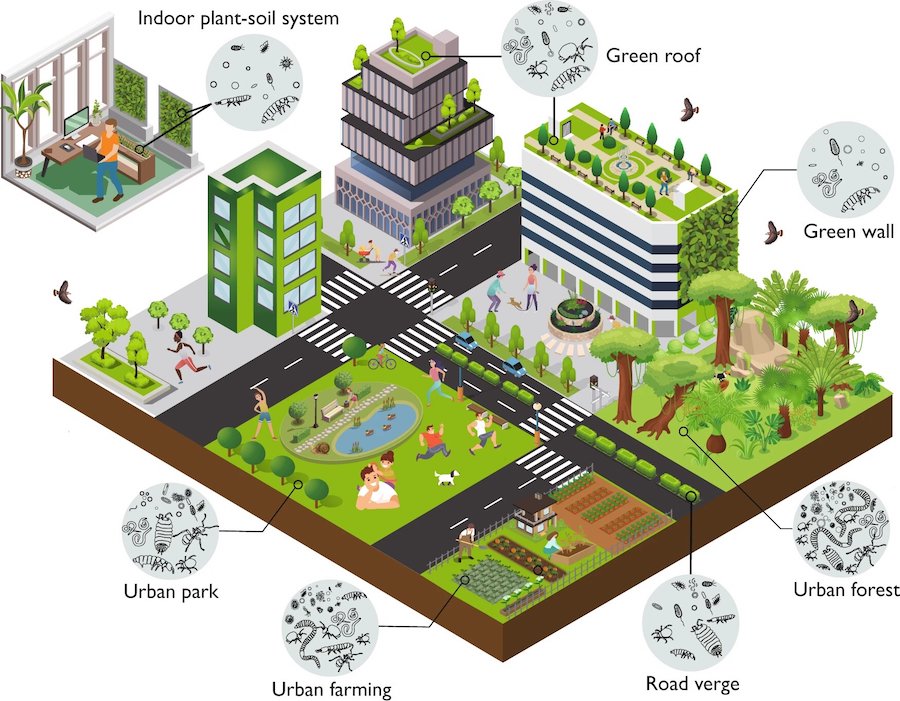
“Unfortunately, land management linked to urbanisation, surface sealing, compaction, pollution, and removal of vegetation can adversely affect soil biodiversity, which traditionally have been one of Earth’s largest reservoirs of biological diversity,” says Flinders University collaborator on the study Dr Craig Liddicoat, a restoration genomics researcher.
“Cities are seeing the collapse of the natural environment, destabilised food webs, and rapid changes to soil biodiversity, which in turn risks creating unhealthy urban environments,” says Associate Professor Martin Breed, who is working with New Zealand’s University of Waikato to investigate the restoration of health-promoting soil biodiversity.
“We need to revisit strategies to rebuild the quality and exposure to soils via restoration, and work on more creative ways of greening and rewilding our cities to improve not only the environment but also our own health.”
As well as large urban parks, researchers point out that private backyards, potted indoor plants, and even road verges, footpaths, and green roofs and walls can all elevate exposure to soil – in tandem with efforts to remediate and remove soil pollutants to regain a balance of soil biodiversity necessary for more healthy city environments.
Conserving and restoring biodiverse green spaces and establishing more green infrastructure benefit soil health by increasing its biodiversity, suppressing pathogens and antibiotic resistance bacteria, and reducing the number of microorganisms associated with methane and nitrous oxide emissions.
Appropriate management of soil biodiversity in cities can reduce the risk of immune-mediated diseases and improve human health in urban environments by reducing pathogens, purifying soil pollutants, and enhancing the human immunoregulation and modulating the human microbiome, the research concludes.
The article, ‘Harnessing soil biodiversity to promote human health in cities’, is published in the journal njp Urban Sustainability.
Organisations involved