

Cities / Sustainability
Plans to regenerate industrial area into healthy, green innovation district
By Andrew Sansom | 14 Dec 2023 | 0
Dutch train company NS and the municipality of Zwolle, east of Amsterdam, have commissioned a team of designers to develop the former business park at the train station in Zwolle and turn the area into a vibrant innovation district with homes for all ages.
The innovation district, called WärtZ, will include about 850 homes, of which around 30 per cent will be social housing. There will also be educational institutions, workspaces for creative makers, catering, and facilities for the neighbourhood. The result will be a vibrant railway park in the area, with the characteristic Wärstsilä hall at its heart.
In the coming years, the site will undergo a spatial and programmatic transformation, following the development framework for the entire railway zone and the memorandum of principles for the NS sub-areas. As part of these plans, Zwolle has set ambitions in the areas of energy, mobility, circularity, and climate, among other things, while the area is also one of 17 earmarked for large-scale housing construction. 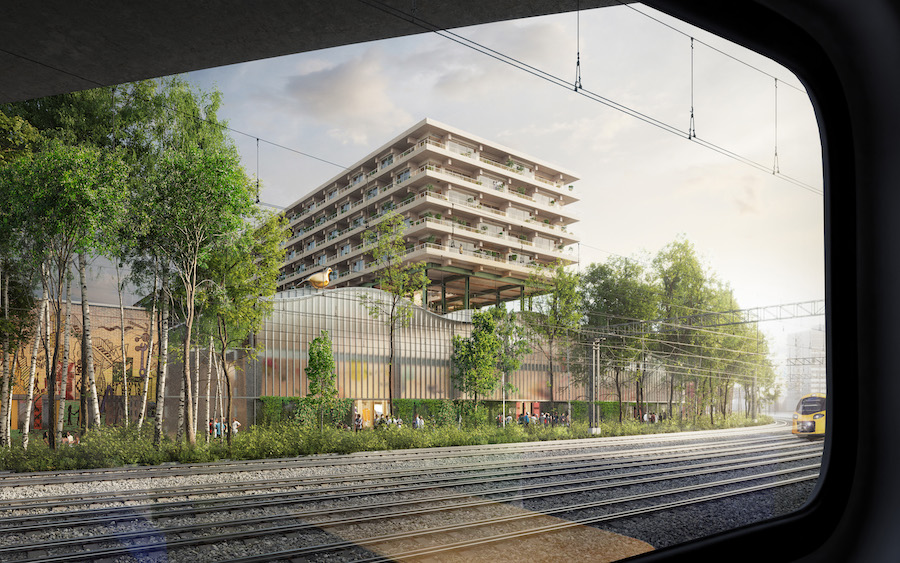
The name WärtZ stands for Wild, Art, Raw, Tech and Zwols, and it is said to reflect the atmosphere of the new innovation district and refers to the existing Wärtsilä Hall, characterised by its undulating roof. The hall itself will provide space for innovative startups, creative companies, and educational and research institutions, as well as forming the stage for events that can open onto the square outside. On top of the hall, a wooden apartment building will be built. A publicly accessible deck will be constructed between the hall and this structure, from which visitors will have a 360-degree view of the hall’s roof, the floodplains of the Ijssel, and Zwolle city centre. This building is described as setting the tone for WärtZ as a circular, sustainable, and green counterpart to the historic city centre.
The project team comprises developer AM, and designers MVRDV, Orange Architects, and LOLA Landscape Architects. In addition to Wärtsilä Hall, MVRDV has designed three mixed-use buildings with housing and workspaces to complete the central part of the innovation district, known as the Werkplaatsen. To the west of this is the sub-area called Lurelui, designed by Orange Architects.
 “I think it’s fantastic to breathe new life into this industrial area for AM, together with Orange Architects and LOLA Landscape Architects,” says MVRDV founding partner Jacob van Rijs. “The Wärtsilä hall, with the new wooden residential building on top, is a good example of sustainable repurposing and densification in the city.”
“The naughty sister”
Doeschka Bos, development manager at AM, describes WärtZ as “the naughty sister of the historic city centre”.
She continues: “The mix of housing typologies, education, facilities, and functions ensures a strong social fabric and opportunities for everyone. Entrepreneurs, educational institutions, the Spoorzone Zwolle Innovation District Foundation, and new Zwolle initiatives have all been involved in the planning process from the outset. We therefore ensure that the innovative ecosystem that was intended gets off the ground and comes to life immediately.”
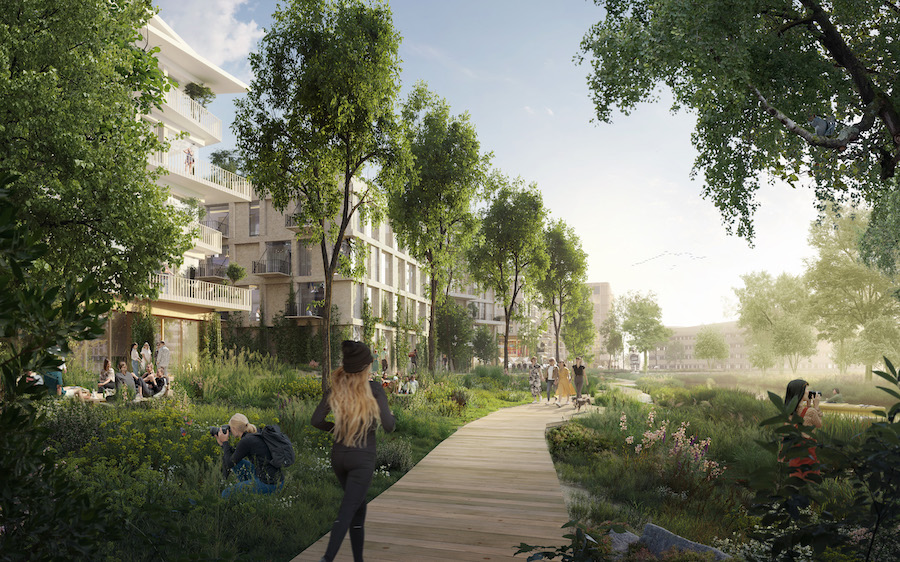
The landscape design by LOLA Landscape Architects is based on the principles of urban rewilding, which returns parts of public space to nature. What is now largely asphalt will become part of a large natural “canvas” for makers, residents, and visitors. Compact residential buildings by Orange Architects in the Lurelui zone are also included in this wild, green canvas.
WärtZ gives priority to walkers, cyclists and public transport users, with appealing slow-traffic routes, multifunctional parking hubs, a wide range of shared transport, and a Bicycle Innovation Centre – all in close proximity to Zwolle Station. The plan fits in with the ambitions of NS and the municipality of Zwolle for a healthy and car-free neighbourhood, and providing the city with potentially the greenest inner-city station area in the Netherlands.
The total area to be developed is 9.5 hectares. The innovation district will be delivered in phases, with the first phase expected to start in 2025.
Organisations involved