

Cities / Sustainability
Planning approved for “UK’s most sustainable neighbourhood”
By Andrew Sansom | 23 Feb 2024 | 0
A brownfield development dubbed “the UK’s most sustainable neighbourhood” has been granted planning approval, a year after the proposals to resurrect the 7.9-hectare site were first unveiled.
Set on a former industrial site in Lewes, East Sussex, within the South Downs National Park, the walkable neighbourhood will be designed to prioritise people over cars. Developer Human Nature, founded by former Greenpeace directors Michael Manolson and Jonathan Smales, aspires to create a blueprint for sustainable placemaking and social impact that can be replicated elsewhere at scale.
The multi-tenure development will provide 685 homes powered by renewable energy – 30 per cent will be deemed ‘affordable’, comprising more than 150 homes at local housing allowance levels and the remainder for first-time buyers through the Government’s First Homes scheme. Once complete, it will be the UK’s largest timber-structure neighbourhood, says Human Nature.
A host of architects were selected as part of a bespoke team. They are Mae; Mole Architects; Al-Jawad Pike; Rabble; Adam Richards Architects; TDO; Ash Sakula; Material Cultures; Charles Holland; Archio; Persicope; Arup; and Human Nature’s design team. In addition, an array of technical consultants, including, among many others, Architecture Ensemble, Atelier Ten, WSP and CBRE, are also involved.
Masterplanning work for the Phoenix was carried out by Human Nature’s in-house design team, regenerative design agency Periscope, and Kathryn Firth, director of masterplanning and urban design at Arup. 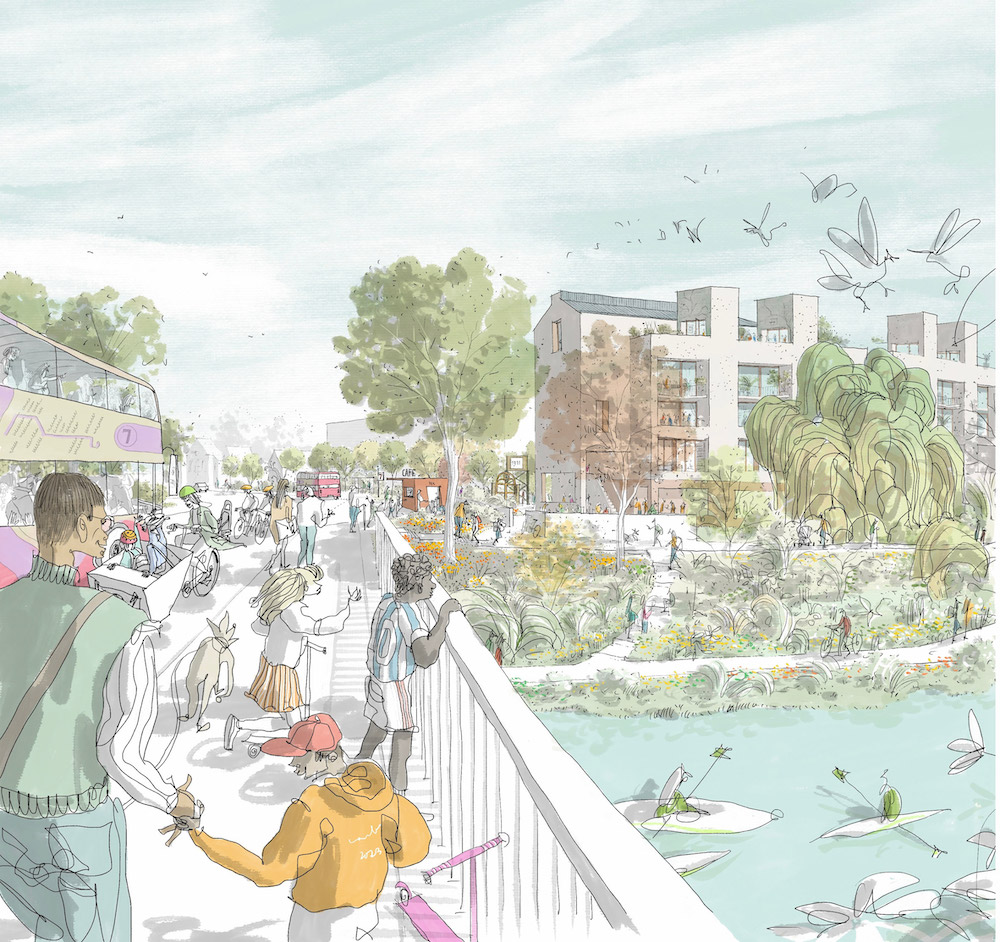
A design and access statement issued last February cites numerous benefits to the local community, in addition to the wide mix of new homes. They include a new health centre; a hotel, meeting and conference facility and restaurant; strategic flood defences for the site; new access to and along the River Ouse; and safe new walking and cycling links through the site and to Malling and the national park beyond. Promoting a shift away from the private care and creating safe streets for active travel, a new co-mobility hub will incorporate electric-car share, a car hire and car club, am electric bike service, and a shuttle-bus facility.
Connections and community
An emphasis on building connections and enabling interaction in shared spaces and facilities threads through the design. The plans feature creative and community facilities, workshops and studios, including a low-cost canteen; skateboarding, bouldering, and music venues for young people; elevated gardens; a nursery; and streets and public squares. Up to 3279m2 of business, employment and flexible workspace will be provided.
Jonathan Smales, founder and chief executive of Human Nature, said: “The current mainstream model of development is catastrophic, baking in deeply unsustainable fabric, infrastructure and transport, fuelling the climate and nature crises. It also creates social divisions and exacerbates loneliness.
“We aim to show that living sustainably can be a joy, not an exercise in self-denial, made far easier by the design of neighbourhoods. We’re working with an amazing team, bringing together best practices in sustainable design, urbanism and construction to provide a new breakthrough model with the Phoenix.”
He added that the development’s focus on “radically improving environmental and social impacts through the power of placemaking” was “a return to traditions we’ve forgotten”.
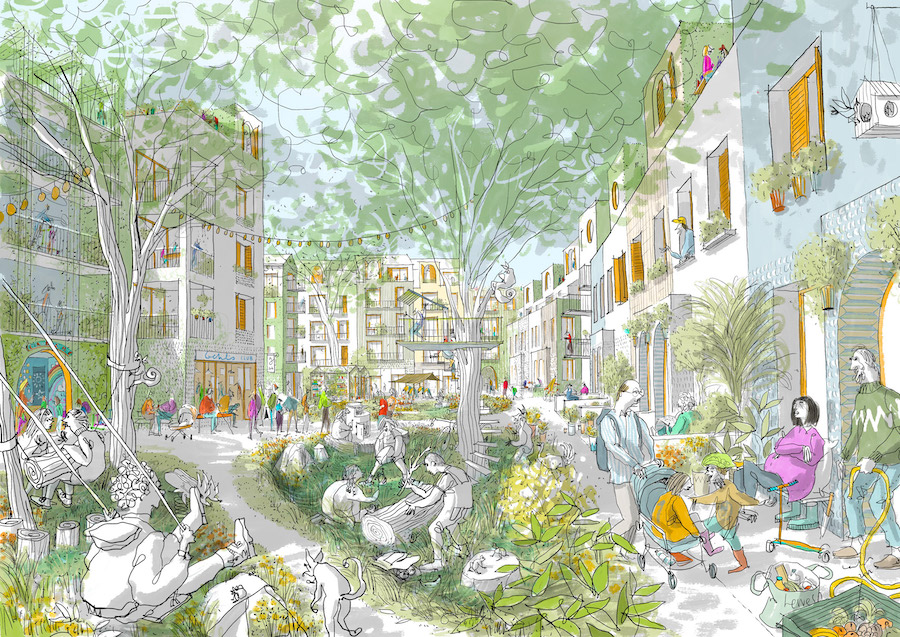 Ash Sakula Architects has been tasked with designing new homes for the development, as part of parcel one. These homes will be interwoven with play areas, communal garden plots and a shared cycle store to promote a culture of shared living. Designed in collaboration with Periscope, a central courtyard gives residents a place to interact, while a rain garden provides protection against flooding.
Climate-conscious and circular economy principles
Sustainability innovations include a data-driven renewable energy system, which aims to cut residents’ energy bills, in addition to on-site recycling, waste-management and composting facilities, and an urban-farming and community gardening strategy.
Circular economy principles are also integrated into the design plans. The Phoenix’s buildings will be constructed from engineered timber, including cross-laminated timber, with prefabricated cassettes made from local timber and biomaterials, such as hemp. Local apprenticeships will be trained on site in modern methods of construction, one of the ways the project will maximise social impact. Where possible, existing materials from the site’s industrial past will be salvaged and repurposed or reconstituted.
Meredith Bowles, principal at Mole Architects, which is designing some apartments and the health centre, said: “While the rest of the world is carrying on as if everything is normal, Human Nature thinks that we have to build in a way that will allow us to live differently in a less hospitable world. But rather than seeing this as a constraint, the Phoenix is an opportunity – for sociable living, for local events, for a greener world. More than anything, it suggests that living sustainably will make for a better life.”
The design and access statement concludes by describing the Phoenix as “a place where people can live well in a way that is also good for the planet”.
It continues: “It is also a place that will address the demographic challenge faced by Lewes, where current projections show that there will be a 22-per-cent increase in the over-65 population in Lewes by 2030, on an already relatively aged population. The Phoenix aims to play a part in reversing this trend by providing homes, jobs and services for our younger generation, as well as meeting the needs of older people who want to downsize, releasing larger properties in the town for families.”
Organisations involved
