

Cities / Inclusive design
Physiological wellbeing should be considered in spatial decisions, pilot shows
By Andrew Sansom | 07 Sep 2023 | 0
The Estonian Research Council has teamed up with the FinEst Centre for Smart Cities team and the City of Narva to develop a wellbeing diagnostics tool that will help bridge the gap between the aims of planners and the views of city residents.
It has been tested in a pilot study, described as the first attempt of its kind to find a link between the human body’s reactions and the quality of urban space.
Stakeholder involvement in urban planning prompts many questions: how and at what stage should you involve key groups interested in planning? How do you generate constructive debate and find common ground at an early stage? How do you achieve a satisfactory outcome for all parties and prioritise conflicting interests? Another key challenge is how to communicate the solution and ensure that all parties understand it in the same way.
The current practice of inclusion in urban planning is largely based on the collection of subjective judgements from city dwellers, says the Council. Typically, surveys are used to find out how people like a proposed urban space, but often people say they’re very satisfied with their living environment and this apparent contentment with everything doesn’t help planners.
People perceive urban space differently
To try to generate more useful data on citizens’ perceptions of urban space, the Council, along with the FinEst Centre for Smart Cities team, at Tallinn University of Technology, and the City of Narva, developed the Citizen Well-Being Diagnostics Service, which considers the psychological and physiological characteristics of test subjects, as well as the spatial parameters of the urban environment.
The tool was tested in a pilot involving 68 volunteer Narva residents from four different age groups. Test subjects were taken to six residential neighbourhoods in Narva and two public space locations: Peetri square and Joaoru beach area.
Using biosensors, volunteers’ stress levels were monitored at different measurement points. Results were combined with a psychological study in which subjects’ emotions, place attachment and recovery potential were mapped at the measurement site. Recovery potential shows the extent to which a person can relax, or recharge their batteries, at a location. The outdoor part of the pilot study not only assessed noise levels but also the proportion of tall vegetation, the amount of asphalt, the ease of use of pedestrian space, and the presence of various points of interest. 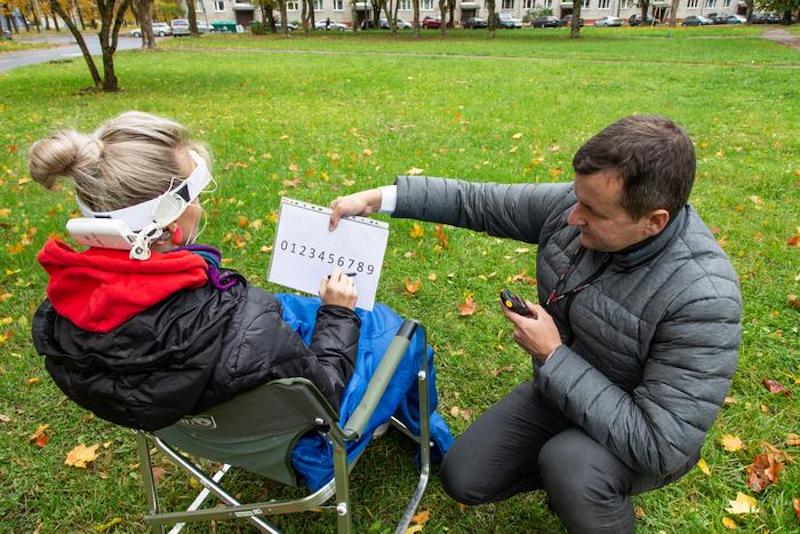
The measured brain signals and cardiovascular physiological responses suggest that people have different physiological perceptions of urban space – strengthening the view that in addition to perception studies, physiological wellbeing should also be considered when making spatial decisions.
Balance is key to quality
The results of the psychological survey were also found to be very weakly correlated with spatial and physiological indicators. This, says the Council, confirms that people do not respond objectively to questionnaires for various reasons. People may knowingly or unintentionally give inaccurate answers that do not reflect their true wellbeing. However, the psychological questionnaire is an important part of the wellbeing score methodology, as it helps to make sense of the results of other parts of the survey. For example, the questionnaire was important to find out how much the subjects themselves rated their negative and positive emotions at the measurement point.
In addition, the results highlighted that no one element is more important than another in urban space. Quality is determined by the balance between the different elements, observe the researchers, who add that a modern urban space must offer users diversity and take account of all needs.
Greenery and landscaping, for example, are important in cities, but the link between these alone and physiological outcomes is weak. Residents thrive in an urban space where no one element dominates over others.
Ultimately, the Citizen Well-Being Diagnostics Service provides urban planners with site-specific recommendations on the spatial parameters to be considered. Based on the recommendations, an expert can assess whether the proportion of some elements should be increased or decreased. A point of equilibrium, where needs are met and opportunities for realising desires are created, can be considered a starting point for wellbeing, both in urban space and in personal life, the researchers conclude.
The researchers say the tool can now be used by other cities, offering the opportunity to engage citizens in crucial decision-making and urban planning processes. More details can be found at www.finestcentre.eu
The pilot projects are fully financed by the European Regional Development Fund and the Estonian Ministry of Education and Research.