

Mixed use / Urban renewal and regeneration
Mixed-use building creates grandstand-style views for Eindhoven residents
By Andrew Sansom | 08 May 2024 | 0
Architectural practice MVRDV has revealed its design for a mixed-use building that provides affordable housing and interconnected green spaces next to the cultural hotspot of Ketelhuisplein, in Eindhoven’s rapidly regenerating Strijp-S neighbourhood.
Designed for housing association Trudo, the building adds 56 apartments, with a mixture of social housing and mid-sector rental units. These sit above a two-storey commercial base, with the design arranged in a stepped, tribune-like shape, which turns the building into a ‘grandstand’ overlooking one of the city’s most vibrant public squares.
The Strijp-S area was originally built as part of the factories of the Philips electronics company, which was instrumental to Eindhoven’s growth in the 20th century. Since Philips’ departure from Eindhoven in the 1990s, the area has evolved into a cultural heart of Eindhoven, serving among other things as one of the main venues of the annual Dutch Design Week. A mixture of creative companies and residents now co-exist in the transformed factories and newly constructed high-rises around the Ketelhuisplein.
Among these buildings are two former factory buildings named after Philips family members Gerard and Anton, as well as the Trudo Tower and the Haasje Over tower, both developed by Trudo. Another key feature is the Leidingstraat (literally “pipe street”), likened to a suspended pergola. It once transported liquids and gases between factory buildings, and in 2014, it was transformed into an elevated garden by landscape architect Piet Oudolf and lighting designers Har Hollands. 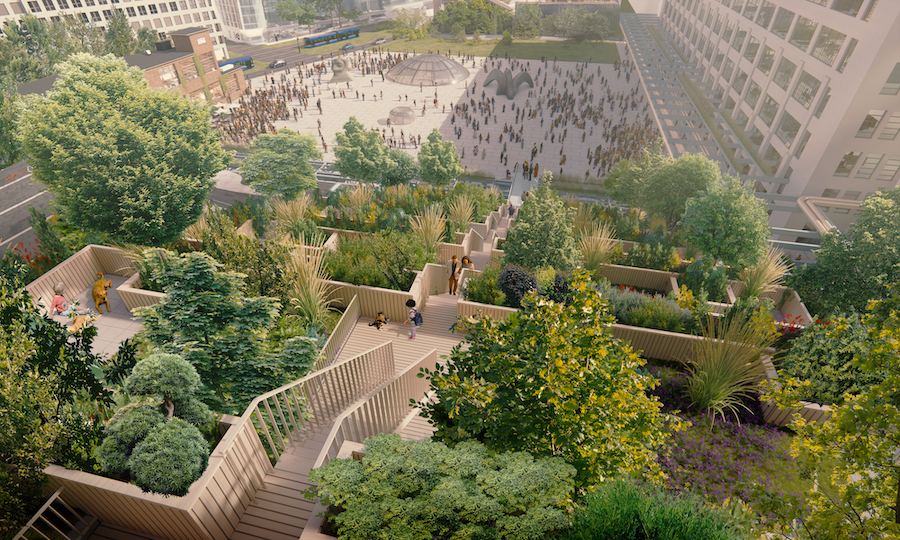
All of these elements play a part in defining the shape of the Strijp-S Tribune. At the rear of the site, the building is eight storeys tall but steps down to just two storeys alongside the plaza of the Ketelhuisplein. The stepping shape also reveals the Anton building, which would otherwise have been visually obscured by a building in this location. While the new building’s shape fits in neatly with its surroundings, its grey-brown timber facade is designed to bring a softer, more natural aspect in a neighbourhood dominated by brick and concrete, while also harking back to some of the wood-based pavilions exhibited during past Dutch Design Weeks.
Terraces and greening
The large terraces created by the building’s steps are generously planted with greenery, with a number of trees, long planters serving as balustrades, and sedum ground coverings, all served by an automatic irrigation system. In this way, the terraces continue the greening of Strijp-S that has been most noticeable in the Trudo Tower, the roof gardens on Anton and Gerard, and the garden on the Leidingstraat – adding to the environmental benefits such as water retention and biodiversity that greening offers.
The terraces offer both private outdoor space for the adjacent apartments, as well as communal outdoor spaces that can be used by residents living deeper within the building. Connected together by staircases, each terrace is accessible from the end of the central corridor on each floor, allowing residents to traverse easily between communal terraces on different levels. The result is a series of spaces suitable for gathering and socialising. From the bottom terrace, a pier projects onto the Leidingstraat, with a staircase extending down to street level, creating a publicly accessible lookout point on the corner of the Ketelhuisplein and turning this series of staircases into a secondary fire escape.
“Without a doubt, Strijp-S is a neighbourhood with extraordinary charisma”, says MVRDV founding partner Winy Maas. “With our design we aim to capture and contribute to the emergent energy of this place, creating a new building that fits seamlessly in its place, while lifting the atmosphere of Strijp-S to the next level. The many features that promote a dynamic and tight-knit residential community in the building are a big part of that.”
Internally, the building hosts commercial functions on the bottom two floors that can be used as retail spaces, a cafe or restaurant, or as offices. The apartments on the floors above are accessed via wide corridors, which receive daylight from both ends and which include internal windows to the apartments. This means that the corridors function more like a small street, encouraging people to get to know their neighbours.
Partners on the project include INBO (engineering); Stam en de Koning (contractor); Tielemans (structural engineer); Kiet (MEP); Peutz (building physics); and BBL (fire safety advisor).
The design proposal was recently presented to the neighbourhood and has been submitted to the Municipality of Eindhoven for planning approval. Construction of the project is expected to begin later this year with completion in 2025.