

Cities / Urban heat island
London heat-risk report highlights socio-economic vulnerabilities link
By Andrew Sansom | 23 Jan 2024 | 0
A new report that maps London’s heat risk across homes, neighbourhoods and essential properties in the face of climate change shows there is a direct correlation between a higher heat risk and areas that have greater socio-economic vulnerabilities.
Produced by global sustainable development consultancy Arup, the report, ‘Properties vulnerable to heat impacts in London’, looks at which of the city’s ‘essential properties’, such as schools, hospitals, care homes, residential buildings and neighbourhoods, would be most impacted during periods of high temperatures.
Arup’s report cites urban heat as a major challenge facing London. Building materials such as concrete and metal absorb heat in the day and emit it at night. In addition, heat emitted from cars and air conditioning units exacerbate the impact of heat in cities, creating an urban heat island (UHI) effect.
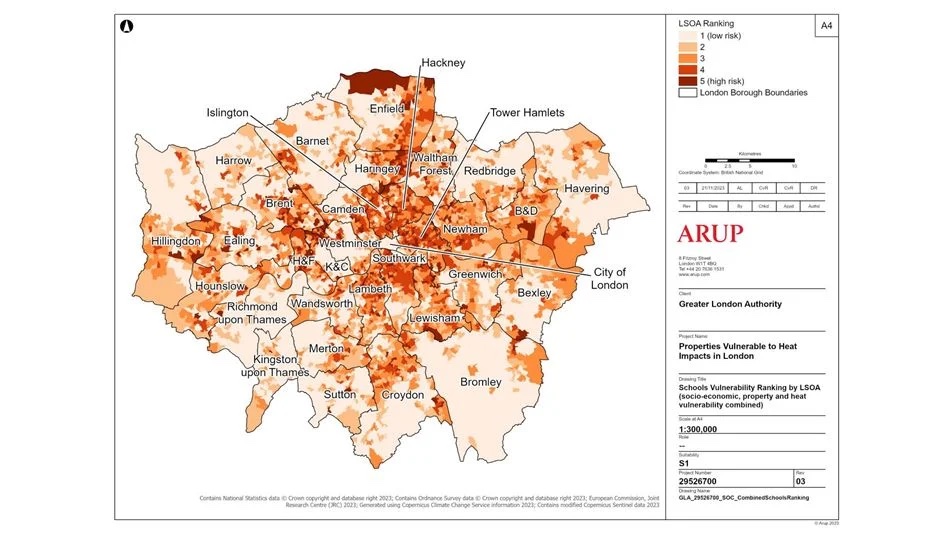
In regard to schools, boroughs such as Islington, Hackney and Tower Hamlets show the greater heat risk, while areas towards the outskirts, such as Hillingdon, Kingston Upon Thames, Bromley and Barnet, show the least heat risk. The north of Enfield is identified as a hotspot, owing to high socioeconomic vulnerability and higher property vulnerability for schools in this area.
For hospitals, there is higher heat risk in areas towards the centre of London, including central boroughs such as Southwark, Tower Hamlets, Hackney, Islington, and Kensington and Chelsea. This also applies to care homes and is down to the UHI effect. Socioeconomic vulnerability is higher towards Central and East London, especially for the Barts Health NHS Trust; Barking, Havering and Redbridge University Hospitals NHS Trust; Homerton University Hospital NHS Foundation Trust; Whittington Health NHS Trust; and University College London Hospitals NHS Foundation Trust. These areas also show a higher heat risk for hospitals. Areas towards the outskirts, such as Hillingdon, Barnet, Richmond, Kingston, Sutton, and Merton show the least heat risk.
For residential properties, there is a higher heat risk in neighbourhoods in central boroughs such as Hackney, Tower Hamlets, Islington, and Camden. These boroughs tend to have a higher proportion of flats, which can be more vulnerable to overheating, compared with outer London boroughs, which have a higher proportion of houses. Areas towards the outskirts, such as Bromley, Havering and Hillingdon, show the lowest heat risk to residential properties.
Resilience policy
The study was published alongside the independent London Climate Resilience Review’s interim report, with both reports commissioned by the Mayor of London to help inform how London and the boroughs should prioritise interventions and adaptations to respond to the climate emergency.
Damien McCloud, director at Arup, said: “We produced this report to quantify which areas and properties are most vulnerable. It’s vital that these findings inform the Greater London Authority’s efforts and broader policymaking so that meaningful interventions can be put in place to protect Londoners in buildings most at risk of overheating. At the same time, London needs a holistic approach to reducing the impact of the different consequences of climate change.”
The report comes after last week’s stark warning from scientists that 2023 was the hottest year on Earth since records began. In the summer of 2022, the UK saw its first ever ‘UK Health Security Agency Level 4 heat alert’, and its first ‘Met Office Red extreme heat warning’. It also follows earlier research assessing the hotspots of seven major cities, including London. Modelling the UHI effect in a city, the ‘Urban Heat Snapshot’ report found that nearly a quarter of a million elderly people and children are living with heat spikes of 4°C in the capital compared with rural surroundings.
Overlaying findings with other data
Shirley Rodrigues, deputy mayor of environment and energy at the Greater London Authority, said: “For some time now we’ve known London is getting hotter – and we need to urgently future-proof the capital against the impacts of a changing climate. The Mayor commissioned this report to help us prioritise the areas and public services that most need adaptation in the face of extreme heat. It’s unacceptable that people living in London’s most deprived areas are the most vulnerable to overheating.”
She added that by making bold choices now, “we can build a better, greener and safer London for all”.
The report highlights an opportunity to overlay these heat impact datasets with other ongoing climate adaptation programmes, such as flood and drought assessments. Integrating the findings, says Arup, could result in insights into multi-faceted climate risks and drive the development of solutions that provide co-benefits, as well as ensuring that solutions designed to protect against one risk factor do not inadvertently cause issues with another.
Organisations involved
