

Women & children's / New models of care
GP-led care model supports emergency department at children’s hospital
By Andrew Sansom | 12 Dec 2022 | 0
In what is believed to be the first of its kind in an Australian paediatric hospital, a new Minor Illness and Injury Clinic has been set up to provide vital support for Queensland Children’s Hospital’s emergency department, while also offering an alternate model of care led by general practitioners (GPs).
The Queensland Children’s Hospital has experienced a significant increase in the volume and nature of presentations to its emergency department since the Covid-19 pandemic, placing pressure on its services and the need to rethink the way patients are cared for in a timely manner.
“Literature at an international level says that 40-50 per cent of all presentations coming through emergency departments could be safely and effectively managed by a GP-led team outside the emergency department setting,” said Perrin Moss, integrated care programme manager at Children’s Health Queensland.
“Acknowledging patients are coming to us because a GP is not available – whether it be outside of business hours, or they’re unable to get an appointment – led us to test a model where a GP would be accessible within close proximity to the emergency department.” 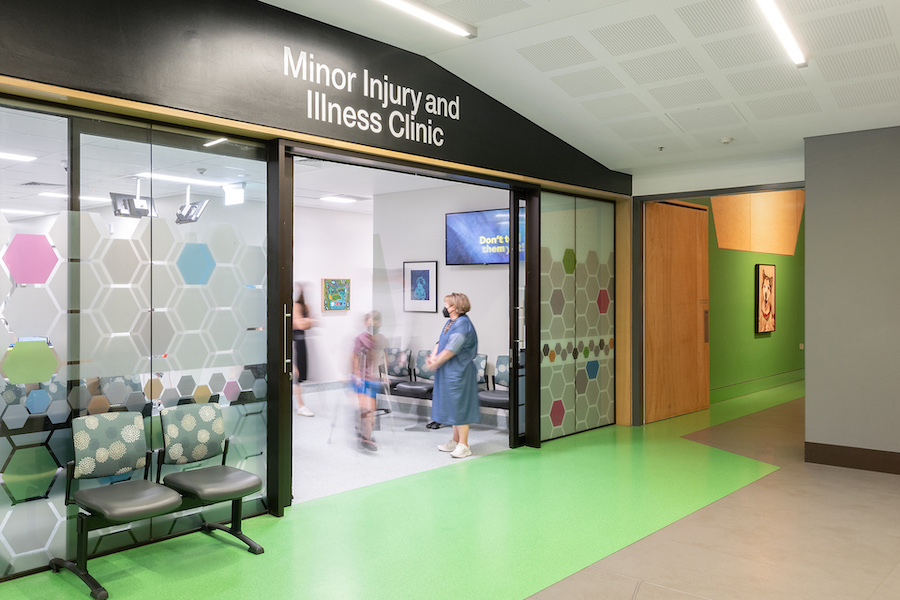
Conrad Gargett was called on to explore a range of options and locations within the existing building for the new Minor Illness and Injury Clinic (MIIC), with the final outcome achieving over double the size and capacity to what was originally conceptualised to include four consultation rooms, a dual treatment space, telehealth room, kitchenette, clean and dirty utility rooms, and an expansive waiting area.
Paul Emmett, principal at Conrad Gargett, explained: “We looked at different areas within the building, from the ground floor right up to level five, but what we went back to was the former convenience store space, which was prime real estate that was underutilised, offered a really good connection to the emergency department, great cross flow and connection to the outside and central atrium.”
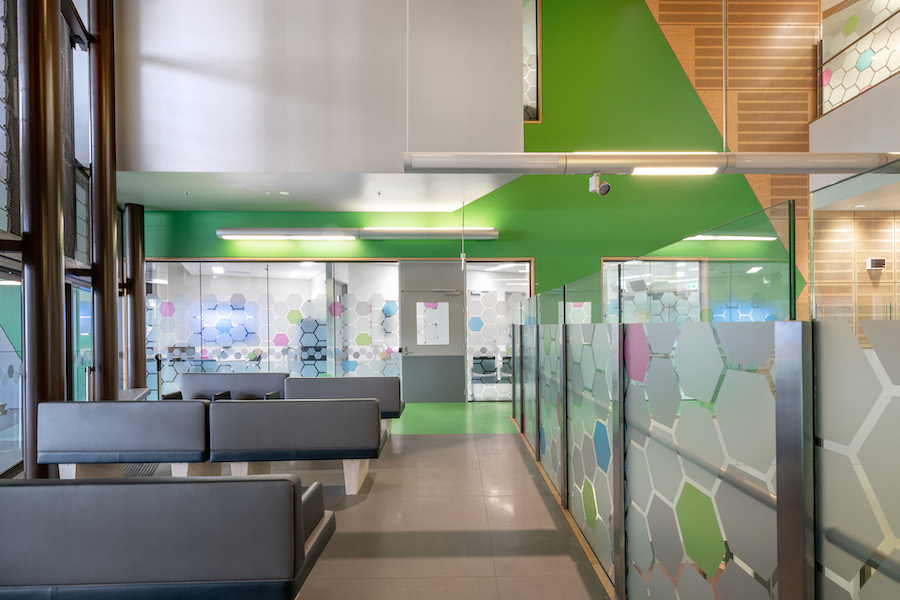
He continued: “Architecturally, we worked that area really hard – we pushed it to make sure that we took full advantage of the engagement with the central atrium and existing large form artwork, and made use of spaces that were underutilised, even outside of the clinic space. 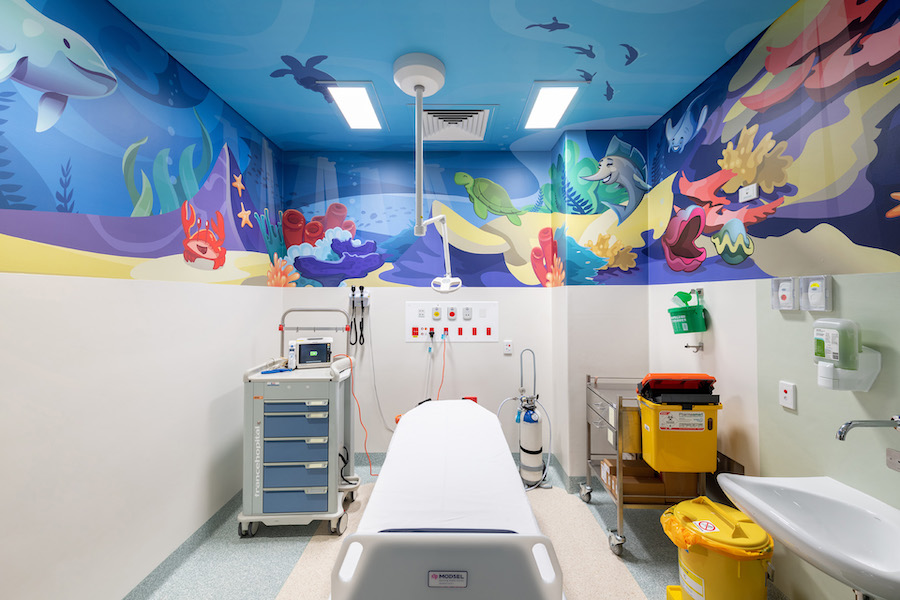
“It has also added more engagement with the main reception – which, from our perspective, we always envisioned would be an activated space.”
Art and the perception of care
Art was a major priority in the project, with Conrad Gargett working closely with senior art curator Lynne Seear, manager of the Arts In Health Programme at Children’s Health Queensland, to integrate art in the design.
“The decision was made at the beginning of the project to have the best art we could find – not to compromise on the quality that happens so often in healthcare facilities because some people have the impression it’s a luxury add on, or there are cheaper ways to do it,” she explained.
“What you have on the walls or floors should match in excellence the quality of care that is being delivered.”
First Nations’ artists are featured front and centre in the MIIC, in line with the hospital’s commitment to having more than 50 per cent of art by Aboriginal and Torres Strait Islander artists.
“Nine out of ten works are by First Nations artists,” said Seear. “We can do that because First Nations’ art is fantastic – it’s really dynamic and diverse and it’s also an obvious a way to announce that a space is culturally inclusive. It doesn’t do the whole job, that’s up to people in their interactions and systems and processes, but it does some of the job.”
 The role of quality art and design at the hospital is also highly valued for its positive impacts on the patient and visitor experience.
“There is a huge degree of thoughtfulness required to put that environment together, which both subliminally and overtly communicates that we want them to have a good experience in the hospital,” observed Seear.
“If people feel safe and comfortable, then their perception of the care that they receive is directly impacted for the better. Perception of care has a huge influence on how people will respond to clinicians, the kind of communications they have, whether they’re listening, whether they will trust the staff and be compliant with instructions, and therefore whether the treatment will be successful and what the recovery will be.”
The MIIC opened in June this year, since when the hospital has received positive feedback about the space from both staff and patients.
“The flow of the patients in and out of the space has also been really effective,” said Perrin. “Once patients are referred to the clinic, it’s between an 8-12 minute wait for them to be seen by a clinician in the MIIC, as opposed to what could be a number of hours waiting in the emergency department, depending on how busy it is.”
Conrad Gargett has continued to be engaged in delivering design services for the hospital since 2014, the year it completed the hospital with Lyons Architecture.
Organisations involved
