

Healthcare / New models of care
Concept whereby emergency vehicles cluster to form pop-up hospital praised
By Andrew Sansom | 11 Jul 2022 | 0
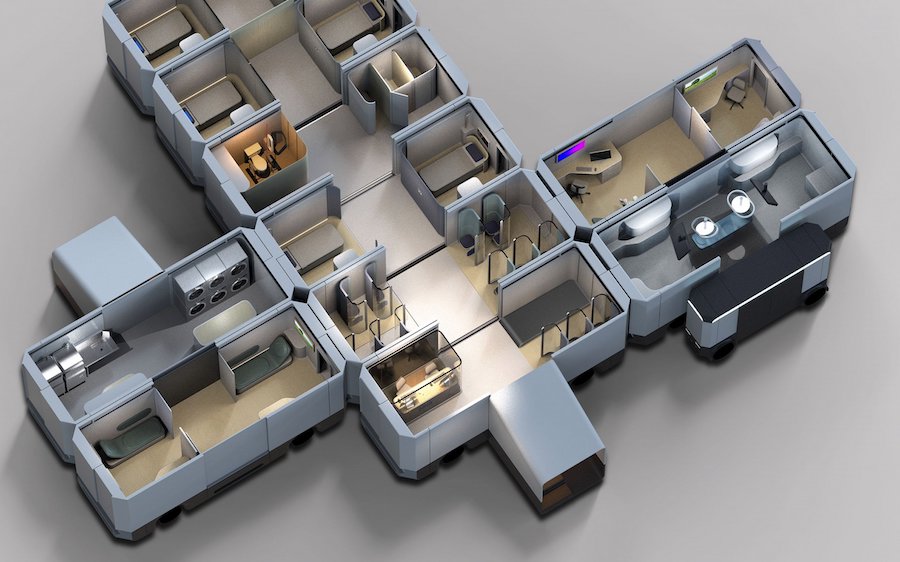
A network of modular autonomous emergency vehicles that can come together and fuse into purpose-built clusters to form an on-the-go hospital is a concept that has taken third prize in Dezeen’s Future Mobility Competition.
Called the National Health Network Modular Hospital System, Mike George’s proposal is designed for emergency situations, enabling hospitals to grow, adapt and respond effectively and flexibly to the situation presented.
Launched in partnership with electric vehicles design and production firm Arrival, the Future Mobility Competition is a global design contest that invites proposals for radical solutions to solve mobility challenges in cities and, in turn, create sustainability and empower local communities. The contest challenges entrants to identify problems with mobility in their city, or a city with which they are familiar, and come up with solutions that could improve how people move about and the future of urban transportation.
In his proposal, George noted that the NHS is currently facing a huge challenge in accommodating soaring demand for its service.
“A huge problem for both ambulance and hospital staff is the smooth planning and deployment of emergency vehicles, due to regular delays and hold-ups when handing patients over to acute hospitals that are often running at capacity with no beds available,” he wrote. “Other challenges for the current ‘one-size-fits-all’ model’s efficiency are geographic variables, such as: a catchment area’s physical size; its population count; average age; how rural or urban an area is; and the spread or density of people living there.”
He pointed to research on the future of healthcare, from architecture and urbanism design studio OMA, which highlights how hospitals are now becoming obsolete more quickly, creating a need for buildings to become more agile and resilient to change.
Modular approach
George said his concept takes inspiration from both the Arrival Elements system and its ‘micro factory’ approach to production.
“Modules would consist of the core elements that make up a functional hospital, with a focus on emergency aid,” he said. “These modules include: general patient wards; surgery theatres; radiology; maternity wards; paediatrics; pathology; reception and waiting areas; GP consultation rooms; nurses’ stations; and utility rooms.
“Each unit, including peripheral components, such as ambulances and patient life support systems, would also be able to connect to and charge from the main grid of the system.”
Each module is said to include a chassis and mobile platform, which can be customised with a mix of interior elements according to different medical situations. The vehicles are also said to feature integrated solar panels fixed to the roof, while there is an option, too, for wind-powered generators to make each module self-sufficient.
The Future Mobility Competition judges included: Kunlé Adeyemi of architecture, design and urbanism studio NLÉ; Elizabeth Diller of New York studio Diller Scofidio + Renfro; and Yves Béhar of Fuseproject. They were joined by Jeremy Offer and Martina Wierzbicki from Arrival, and the late Marcus Fairs and Cajsa Carlson from Dezeen. The panel selected the National Health Network Modular Hospital System as third place in the competition.
“This concept isn’t about individual vehicles, but more about larger societal needs,” said the judges. “It thinks big and in a systematic fashion.” They described the concept as “beautifully designed and executed” and “very relevant considering the pandemic we just came out of”.
The contest received in excess of 170 entries from more than 45 different countries. A final shortlist of ten was revealed, with the winner receiving a top prize of $25,000, the runner-up $15,000, and the third-placed entrant $10,000. Each of the seven remaining finalists will receive $5000.
Organisations involved