

Healthcare / New models of care
Ambulatory care model reworked through streamlining and space planning
By Andrew Sansom | 15 Jul 2024 | 0
Jefferson Health recently opened the Honickman Center, now home to more than a dozen specialty practices previously scattered throughout ten buildings.
Serving as the architect of record for fit-out of the building, Stantec partnered with Ennead Architects, the core and shell architect, to help plan the facility for its intended ambulatory care use.
Located in the heart of Center City Philadelphia, the $762 million, 462,000-square-foot facility serves as a catalyst for changing the health system’s delivery of care. Virtual and technology strategies have helped elevate physical space planning, engaging patients and offering convenience during the pre-arrival stage of care. In addition, valet and concierge services support a smooth, welcoming experience on arrival. 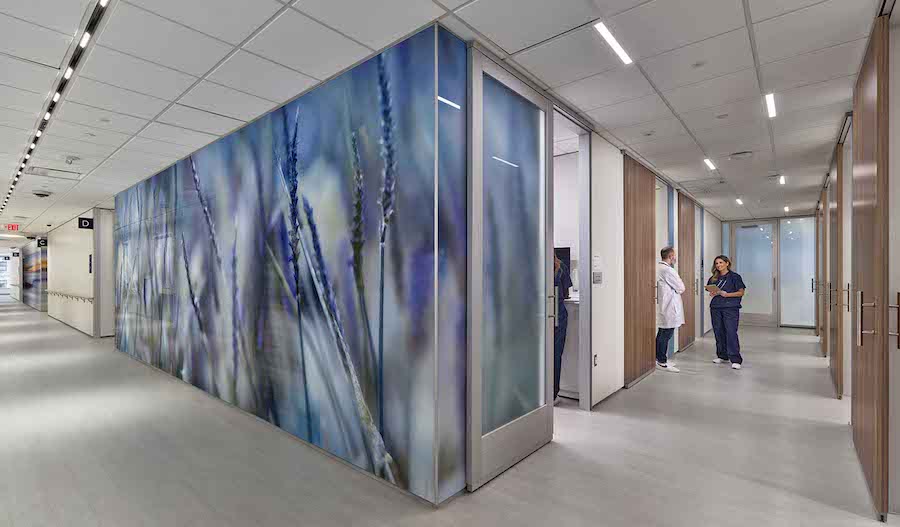
Reimagining care with the support of new technologies allowed the design team to eliminate spaces and streamline processes.
Traditional steps along a patient’s journey were eliminated by bringing services to the patient at their point of care; for example, the intake process, which typically requires stopping at an alcove to collect height and weight information, now occurs in the private exam room. Information is automatically transmitted to the patient’s electronic medical record, using smart exam tables.
“By collaborating closely with the care team at Jefferson Health, we were able to create process improvements that enhance the patient experience, staff workflow, and spatial implications,” said Kristy Hollis, principal for Stantec. “We’re proud to help create a place where our Philadelphia community can receive the best comprehensive care that supports their health and wellbeing.”
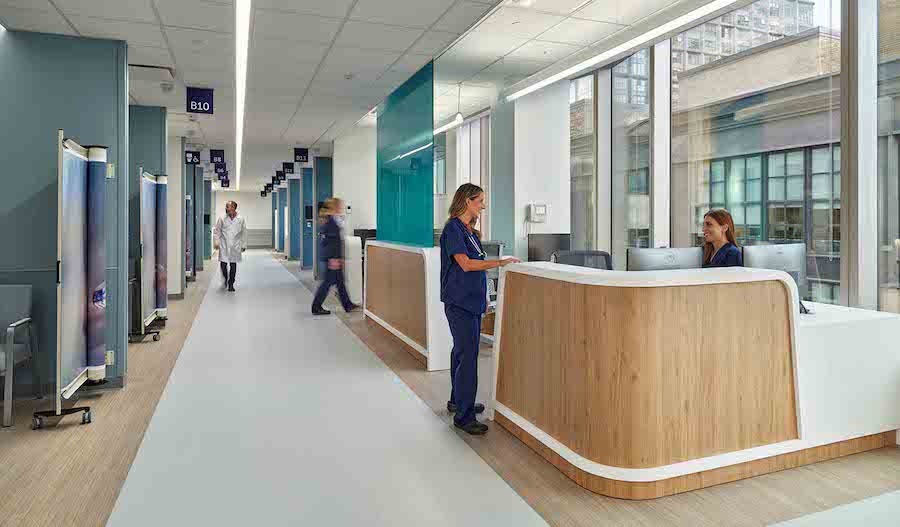 The Honickman Center comprises more than 300 exam rooms; 58 infusion chairs; eight operating rooms; five endoscopy rooms; imaging; lab services; and a pharmacy. The tower also features two levels of amenity space available to patients, visitors and the public, and include a large cafe, a community event space, and a large-scale lounge area. As patients move up to the clinical floors, public spaces are smaller and support a calm experience. Amenities continue with programmes such as image recovery and lounge space for cancer patients and access to a rooftop terrace on the 15th floor.
Modular exam rooms and inclusive design
Construction logistics did, however, present a challenge to delivering this vertical campus. With only inches between the building perimeter and property line, all construction activity had to occur within the footprint of the building itself. Standardising the building layout and prototyping exam spaces allowed for more than 300 exam rooms across ten storeys to be fully built out of prefabricated demountable partitions and a standard kit of parts. This, says Stantec, enabled the floors to be handed over to Jefferson Health months quicker than if traditional stick-built methods had been used.
With an estimated 15-20 per cent of the global population classified as neurodivergent, the design also sought to reduce stress by considering the needs of both neurodivergent and neurotypical patients. On arrival, patients can obtain sensory support kits. Neutral yet warm finishes, free of bold patterns, set a calming and welcoming tone. Waiting spaces provide large- and small-scale seating that integrate tactile elements, soothing motions, or reduction in ambient noise. These areas also include feature walls and dynamic art installations aimed at reducing anxiety and providing positive distraction. Glazing is used at many of the transitions between environments, helping patients anticipate and prepare for what is next in their journey.
In its efforts to create an inclusive environment for care, the design team was supported by leaders from the Jefferson Center for Autism and Neurodiversity, as well as receiving input from neurodivergent focus groups.
Organisations involved
