

Primary & community care / Sustainability
Active travel integration and nature links feature in community hospital plans
By Andrew Sansom | 09 Jan 2023 | 0
A planning application for a new community hospital in the North East of England town of Consett includes a strong focus on health promotion through sustainable transport and connections to nature.
Designed by Medical Architecture for County Durham and Darlington NHS Foundation Trust, the project is in cohort 2 of the New Hospital Programme, which is targeting the building of 40 new healthcare facilities in England by 2030.
Employing a holistic approach to health and wellbeing, Shotley Bridge Community Hospital is designed to provide opportunities for patients and staff to connect with the outdoors and benefit from the therapeutic qualities of nature.
Arranged around two large, landscaped courtyards, the new hospital will offer a range of facilities including outpatient services and diagnostics, an urgent care centre, a medical investigations unit for cancer services alongside a chemotherapy day unit, family health services, and a 16-bed rehabilitation inpatient ward. Sited on the edge of Consett with access to the County Durham countryside, the hospital will be located just 1.8 miles from the existing Shotley Bridge Hospital, which will be replaced as it requires significant investment to maintain the outdated estate. 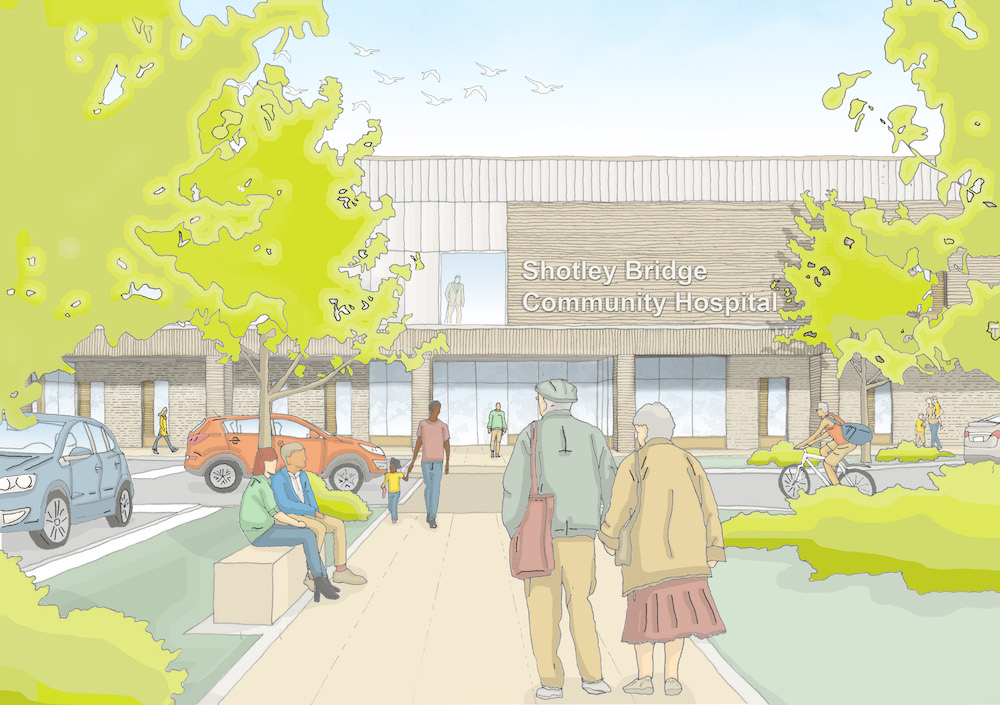
Coastal links and healing spaces
Encouraging sustainable means of transport, the site masterplan and hospital building have been designed to create a new pedestrian and cycle link, which connects with the Coast-to-Coast cycle route that runs adjacent to the site, and a new footpath leading from the town centre.
Sitting at the entrance of a wider site masterplan envisioned as a parkland, the idea of a ‘pavilion in the park’ was a key design concept for the new hospital. This is reflected in the human-scale building form, careful composition of a simple material palette, and a landscaping strategy that promotes biophilic interactions and a harmonious relationship with the site’s context.
A primary entrance at the front of the building provides access to the inpatient ward and outpatient departments. On the opposite side, a pedestrian entrance connects with the proposed footpath. These are connected by a central public concourse through the building, with a public cafe and clear wayfinding to all facilities.
The courtyard design helps bring natural daylight deep into the heart of the building and offers almost all occupied rooms an outside view. The courtyard spaces, with landscape design by One Environments, feature planting described as rich in texture, form and colour.
A ‘Serenity Garden’ is accessible to visitors, patients and staff, and features a mixture of open and semi-private seating spaces, so people can rest in comfort with family and friends. The ‘Healing Garden’, meanwhile, has been developed in collaboration with clinical staff as a private, therapeutic space available to patients and staff to support rehabilitation.
 Internally, biophilic design principles provide direct and indirect connections to nature to create an uplifting healthcare environment. As well as benefiting patients, this also promotes wellbeing in the workplace and supports a positive culture of care.
Civic presence at a human scale
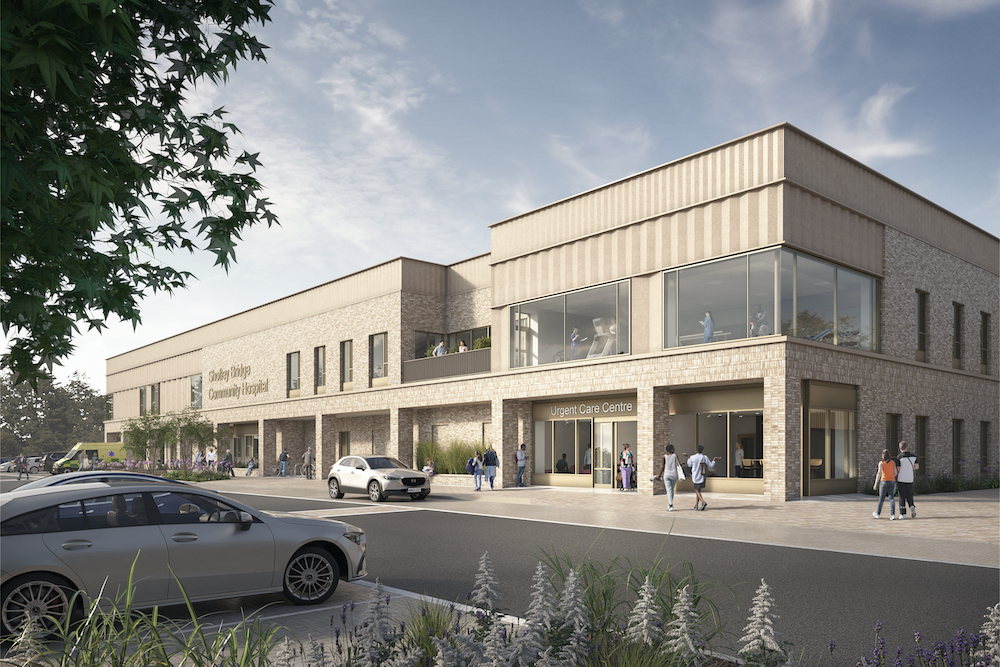
Designed as a recognisable civic building, the community hospital features a colonnaded canopy on either side of the building, breaking down the scale of the building and mediating the transition from the car park and the proposed public footpath. Intermediary spaces between outside and inside are designed to be welcoming while providing legible markers for entrances. Combined with external seating provided between brick piers and well-proportioned windows, these elements reinforce the message that the hospital is part of and for the local community.
Sandstone has commonly been used for civic buildings in County Durham, and the material’s warm tones, soft hues and hard-wearing qualities convey a reassuring sense of permanence. To draw on this, the predominant external cladding material is a textured, ‘multi’ light buff brick, which is described as robust and has similar visual qualities to the local sandstone architecture. In addition, bandings of profiled glass-reinforced concrete panels are introduced to emulate the texture and solidity of stone in a crafted form. An undulating, perforated metal rainscreen is proposed as a crown to the top storey of the building, paying homage to the historic significance of the site as part of the former Consett Steelworks.
Sustainability and net-zero principles
The hospital has been designed to achieve BREEAM Excellent and adopts the NHS’ net-zero carbon standards as a guiding principle, limiting the hospital’s operational and whole-life carbon footprint. 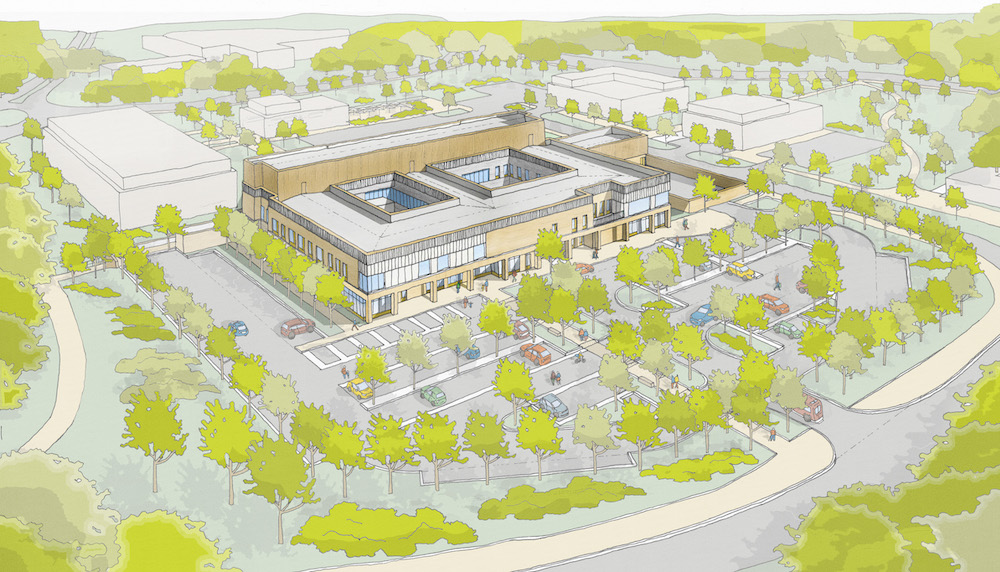
Longevity has been prioritised over short-term opportunism, adds the architect, with the facility designed to be flexible and adaptable to enable it to accommodate changing models of care and service delivery for generations to come. Principles of standardisation and repeatability have been adopted to optimise efficiencies and ensure future adaptability in the building layout.
The project is also committed to using modern methods of construction (MMC). Working alongside MMC consultant Akerlof, the design team has adopted a framework of core principles, which include design for manufacture and assembly, and the use of prefabricated systems and offsite manufactured components.
Commenting on the project, Lianne Knotts, director at Medical Architecture, said: “From very early design stages, the importance of this new hospital was clear, and we set out to design a place that inspires a sense of local pride. The building is welcoming to all and creates an environment for care that promotes wellbeing and recovery. While enabling the highest current standards of healthcare, it has the flexibility to adapt to the future health needs of the community.”
Jane Curry, programme manager for County Durham and Darlington NHS Foundation Trust, said: “This is an exciting development for the local population in Derwentside and the wider County Durham healthcare community. It’s part of the Government’s pledge to build or significantly expand 48 new hospitals: Shotley Bridge has been identified as a cohort 2 development.
“We look forward to continuing discussions with our NHS colleagues and the local communities and progressing the scheme over the next few years.”
The project team also includes A.E. Robb & Associates as M&E engineer, and Jasper Kerr as structure and civil engineer.
